


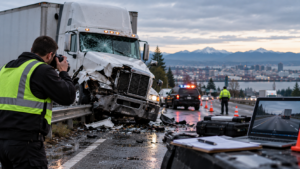
The Six-Month Clock: What Disappears From Your Case File If You Wait Too Long
After a truck crash in Everett, you may face treatment, missed work, repair bills, and calls from insurers. Questions about the cause may take longer. Was the driver tired, did a mechanical problem contribute, or did a camera record the collision?
Answers may sit in files held by a trucking company, repair shop, public agency, or nearby business. Some systems overwrite information during normal operation, so early preservation can matter while you recover. Consult with an Everett Truck Accidents lawyer to discuss what options you have.
What Does the Six-Month Clock Actually Mean?
Under 49 CFR § 395.8(k), a motor carrier must retain covered records of duty status and supporting documents for at least six months after receipt. These records document a driver’s duty status; the rule does not cover every file tied to a crash. The Federal Motor Carrier Safety Administration explains the ELD retention requirement.
As of October 2026, the federal rule still sets this six-month minimum. Carriers do not necessarily delete records on day 181, and other duties may require further preservation. Maintenance files, video, accident registers, and event data recorders follow different rules or practices. Do not assume they will remain available until the lawsuit deadline.
Six Types of Truck Accident Evidence That May Disappear
1. Electronic Logging Device Records
An electronic logging device, or ELD, documents a commercial driver’s duty status. It can show when a driver was driving, resting, off duty, or working without driving. Investigators may compare those entries with dispatch records, delivery times, and the crash timeline.
If fatigue or hours-of-service compliance becomes an issue, a log may help establish the driver’s schedule before a collision in Everett or Snohomish County. It cannot prove fatigue caused the crash on its own. Because the retention rule covers these records, identify the relevant driver, truck, dates, and data early.
2. Dispatch Records and Supporting Documents
An ELD log tells only part of the story. Dispatch and trip records may show where the driver was sent, what deliveries were scheduled, and how the workday unfolded.
Under 49 CFR § 395.11, covered supporting documents include:
- Bills of lading, itineraries, schedules, or similar trip records.
- Dispatch and trip records.
- Certain expense receipts for on-duty, non-driving time.
- Electronic mobile communications sent through fleet management systems.
- Payroll records or settlement sheets showing driver payment.
These materials can help compare driver logs with work performed. A focused preservation request is usually more useful than a broad demand for every file. The records needed depend on the crash.
3. Truck Inspection and Maintenance Records
Brake problems, worn tires, steering defects, and other mechanical issues may contribute to a truck crash. Maintenance files can show whether a company recorded a defect, arranged a repair, or inspected the vehicle before the collision. 49 CFR § 396.3 sets federal requirements for inspection, repair, and maintenance records. Those requirements differ from the ELD rule, so do not apply the six-month period automatically to every maintenance document. Relevant records include inspection reports, repair orders, invoices, and defect reports. A third-party shop may hold them, so identify that business as well as the carrier.
4. Event Data Recorder Information
An event data recorder, or EDR, is often called a vehicle’s “black box.” It differs from an ELD. An EDR can capture selected technical information for a short period around a crash, such as vehicle movement, driver inputs, or restraint deployment. The National Highway Traffic Safety Administration explains EDR data and its limits.
EDR information may help investigators examine braking, speed, or other recorded behavior. Systems differ, and no single retention period applies to every EDR. Access depends on the device, event, and vehicle condition. A qualified investigator may need to identify the system and extract data. The preservation request should identify the truck and data at issue. Do not remove or access the device yourself.
5. Dashcam and Nearby Surveillance Video
Video may show vehicle positions, traffic movement, or what happened just before impact. Potential sources include the truck, another driver, a nearby business, or a public agency. Around Everett, footage may exist near an intersection, loading area, or commercial property. Some cameras overwrite recordings; others save event clips or use longer schedules. No single retention deadline applies to every system.
Public agency recordings follow agency-specific rules. The Washington State Archives explains law enforcement recording retention, but those schedules do not establish retention periods for every private business. If a camera may have captured the crash, identify its owner and request preservation promptly. A public-records request may help obtain existing footage, but it may not solve every preservation issue.
6. Witness Information, Photos, and Physical Evidence
Some evidence has no formal retention policy. Witnesses may move or forget details, and roadwork or weather can change the scene. Keep original photos and videos with the date and location, plus relevant messages, estimates, medical records, and correspondence. Do not edit images to change what they show. If someone saw the crash, keep their name and contact information. You do not need to persuade them to agree with your version. Preserve their details so the events can be reviewed accurately later.
What If Truck Accident Evidence Goes Missing?
Missing records can complicate crash reconstruction. Investigators may struggle to test a mechanical problem, check the driver’s schedule, or compare data with witness accounts. Still, missing evidence does not automatically prove that the trucking company caused the collision. Washington courts consider the circumstances, including the evidence’s importance and the party’s conduct. In Tavai v. Walmart Stores, Inc., the Court of Appeals declined to draw a spoliation inference on the record before it. The court noted uncertainty about when the footage disappeared and whether the company acted in bad faith.
Put simply, a missing file does not guarantee a legal win. The circumstances matter. Early action may help establish what records existed, who controlled them, and whether anyone requested their preservation.
The Six-Month Rule Is Not Washington’s Lawsuit Deadline
Washington generally allows three years for covered personal injury actions under RCW 4.16.080. The deadline for a specific claim can depend on the parties and circumstances. Records may become unavailable long before the filing period ends.
Claims involving a local government entity can require a formal claim before suit. Under RCW 4.96.020, a covered tort claim generally cannot proceed to a lawsuit until 60 calendar days after presentment. Special circumstances may affect the analysis, so do not treat these general rules as advice about your own deadline.
How to Protect Evidence After an Everett Truck Accident
You do not need to investigate the crash yourself. Start with steps that protect your health and preserve information:
- Get medical care and report the crash. Keep available incident details and treatment records.
- Save photos and documents. Keep original images, damage photos, repair estimates, bills, and relevant messages.
- Write down what you remember. Note the date, location, weather, direction of travel, and sequence of events while the details are fresh.
- Record witness details. Save names and contact information without asking anyone to change or coordinate their account.
- Identify possible evidence holders. The carrier, truck owner, repair shop, insurer, camera operator, or public agency may control different records.
- Ask about a preservation request. It can identify the truck, driver, date, ELD information, dispatch documents, maintenance records, EDR data, and available video.
How an Everett Truck Accidents Lawyer May Help
A lawyer can identify evidence sources, review the crash report, and send preservation requests. The investigation may involve driver logs, maintenance records, cargo paperwork, video, or an expert inspection. Read what to know before settling an Everett truck accident claim or learn about truck wreck attorneys in Washington. The relevant records depend on the facts.
When you speak with an Everett truck accident lawyer, ask which records may matter, who controls them, and how they may be preserved. A responsible review should explain options without promising a result.
Frequently Asked Questions
How long must a trucking company keep ELD records?
Federal rules generally require covered duty-status records and supporting documents to be kept for at least six months from receipt. That minimum does not apply to every type of accident evidence.
Can a trucking company delete records after six months?
The rule sets a minimum retention period for specific records. It does not mean every file can automatically be destroyed after six months. Other requirements or circumstances may call for preservation.
What is the difference between an ELD and an EDR?
An ELD records a driver’s duty status. An EDR captures selected technical vehicle information around a crash. They serve different purposes and have different retention considerations.
Should I wait until I file a lawsuit to preserve evidence?
No. Some systems overwrite information, and witnesses can become harder to reach. Early, targeted action may help preserve useful material.
Everett Truck Accident? Protect the Evidence That Matters.
Evidence may help explain how a truck crash happened and who may be responsible. Brumley Law Firm can discuss your situation and explain the steps that may help preserve relevant records before they become harder to obtain. Contact Brumley Law Firm About Your Truck Accident to discuss your concerns and understand your legal options.