
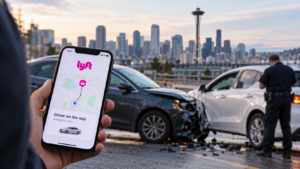
Lyft’s Insurance Gap: The 60 Seconds That Decide Who Pays After a Seattle Crash
In a Lyft crash, the app’s status at the moment of impact decides which insurance applies. If the driver was logged in but hadn’t accepted a ride, Washington requires coverage of $50,000 per person and $100,000 per accident. Once a ride is accepted, the required limit jumps to $1,000,000. A short window of app data can decide whether your claim has a ceiling in the tens of thousands or in the millions.
If you were hurt in a crash involving a Lyft driver in Seattle, you’ve probably noticed that nobody can tell you quickly who is paying for what. That’s because there isn’t one policy. There are several, and which one applies depends on what the driver was doing in the app when the crash happened. Sorting that out is a large part of what a Lyft accident lawyer Seattle does, and it’s why these claims behave differently from an ordinary two-car crash.
Why the App Status Changes Everything
Washington’s commercial transportation services insurance law, RCW 48.177.010, sets different minimum coverage depending on what the driver is doing:
| Stage | What’s happening | Required coverage |
| App off | The driver isn’t logged in | The driver’s personal auto policy, which is typically what applies |
| App on, no ride accepted | The driver is logged in and waiting for a request | $50,000 per person, $100,000 per accident for bodily injury, and $30,000 for property damage |
| Ride accepted through drop-off | A prearranged ride is under way | $1,000,000 combined single limit, plus $1,000,000 in uninsured and underinsured motorist coverage |
Washington defines a prearranged ride as starting when the driver accepts the request and ending when the passenger leaves the vehicle. That means a driver who has accepted a ride and is still heading to the pickup is generally already in the higher-coverage stage.
The Gap Is Where Claims Get Fought
The difference between $100,000 and $1,000,000 is the gap. A serious injury, with surgery, hospital stays and months away from work, can run well past the lower limit. So when a crash happens near a status change, the dispute is predictable:
- A driver who just tapped “accept” or just finished a trip may be argued to be in the lower-coverage stage.
- A driver who switched the app off right after the crash may say they were never working.
- The driver’s personal insurer may deny the claim because the driver was working through the app.
- Lyft’s insurer and the driver’s own insurer may each point at the other.
These disputes often turn on a very short stretch of app and GPS data. For how fault itself gets decided in these cases, see our guide to how liability is determined in a rideshare accident.
Who Can Make a Claim
The coverage questions affect more than passengers. Depending on the facts, claims can come from:
- Passengers in the Lyft vehicle
- Drivers, passengers, cyclists and pedestrians hit by a Lyft driver
- Lyft drivers hurt by someone else’s negligence
Each person may be able to reach a different combination of policies, including your own uninsured and underinsured motorist coverage. Our page on rideshare injury lawyers in Washington explains how these claims work across Uber and Lyft.
What To Do in the First Few Days
- Get medical care. Document every symptom, even mild ones.
- Screenshot the ride. If you were a passenger, capture the trip details, driver name, car, and plate before they disappear from the app. Save the receipt email.
- Report the crash. Get the police report number and the other driver’s information.
- Don’t give a recorded statement yet. Adjusters may ask early, before anyone knows which coverage applies.
- Preserve evidence. Photos, witness names, and any dashcam footage matter. App and GPS data usually have to be formally requested, which is one reason to act early.
Do You Actually Need a Lawyer?
Not always. If nobody was hurt, damage is minor, and the insurer is already paying, you may not need one. A lawyer becomes more important when injuries are serious, the driver’s app status is disputed, an insurer is denying responsibility, or you’re being offered a settlement that doesn’t cover your bills.
What If the Insurance Company Already Offered You Money?
You aren’t required to accept. Early offers often come before your treatment is finished and before the full cost of your injuries is known. Signing a release usually closes your claim for good, even if your condition gets worse later. Have the offer reviewed before you sign.
Washington Law That Affects Your Claim
Washington follows a pure comparative negligence rule under RCW 4.22.005, so if you share some fault, your recovery is reduced by your percentage but not eliminated. You generally have three years to file a lawsuit under RCW 4.16.080, but app data and other evidence can disappear much sooner.
Why Brumley Law Firm
Joshua Brumley began his career working for insurance companies, so he knows how adjusters evaluate rideshare claims and where they look for ways to shift responsibility. He has practiced law in Washington since 2015, and you can verify his license through the Washington State Bar Association. We work on contingency, so you pay no attorney fees unless we recover compensation for you. Past results do not guarantee future outcomes, and every case depends on its own facts.
Frequently Asked Questions
Does Lyft’s insurance cover me if the driver didn’t have a passenger?
It can. If the driver was logged into the app and waiting for a request, Washington requires liability coverage of $50,000 per person, $100,000 per accident and $30,000 for property damage. That is much lower than the $1,000,000 that applies once a ride is accepted.
What if the Lyft driver turned off the app after the crash?
That doesn’t erase what they were doing at the moment of impact. App and GPS records can show their status, but they usually need to be requested formally, so it’s best to act early.
Can I sue Lyft or only the driver?
It depends on the facts, including the driver’s status in the app and who was at fault. A lawyer can identify every party and policy that may apply.
What if the other driver, not the Lyft driver, caused the crash?
You’d generally pursue the at-fault driver’s insurance. If their coverage is too low, your own uninsured and underinsured motorist coverage may also help. The Lyft policy may still matter in some situations, depending on the circumstances.
How long do I have to file a claim after a Lyft accident in Washington?
Generally three years from the date of injury under RCW 4.16.080, though shorter deadlines can apply in some situations.
Conclusion
After a Lyft crash, the question of who pays rarely has a simple answer, and the difference between the lower and higher coverage stages can change what your claim is worth by hundreds of thousands of dollars. Preserve your evidence, be careful with early statements and offers, and get the app status question answered early. If you’re looking for a Lyft accident lawyer in Seattle, call our Seattle office at (206) 737-1705 for a free consultation, available 24/7. There is no fee unless we win.