
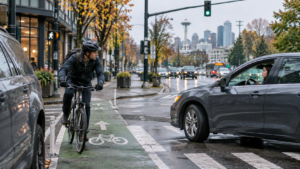
Seattle Bicycle Accidents: Why Fault Gets Disputed More Than Any Other Crash Type
After a bicycle crash in Seattle, the driver and cyclist may describe the same event differently. A driver might say the cyclist appeared suddenly. The cyclist might recall a turn across the bike lane. These disagreements can affect insurance decisions and injury claims. They often turn on details that a quick glance cannot resolve. No reliable public dataset establishes that bicycle crashes generate more fault disputes than every other crash type. Still, visibility, road position, and conflicting accounts can make fault difficult to assess.
Why Fault Can Be Difficult to Establish
A collision can happen within seconds, and each person sees it from a different position. A short video may show impact but miss the approach. A witness may see the collision without knowing who entered first. A police report may record statements without resolving every civil liability question. Investigators compare accounts with available evidence to assess what each person did, what each could see, which rules applied, and whether the conduct caused the injury.
Which Facts Commonly Become Disputed?
Could the Driver See the Cyclist?
Visibility often becomes a central issue. Parked vehicles, delivery trucks, street furniture, lighting, and turning angles can affect sight lines. A driver may say a cyclist appeared suddenly. The cyclist may say the vehicle turned without checking the bike lane. Near downtown Seattle, investigators may examine the vehicle’s approach, the cyclist’s direction, obstructions, and timing. “I did not see the cyclist” does not settle whether the driver acted reasonably.
Was the Cyclist Riding in a Lawful Position?
Disputes can involve lane position, direction of travel, or movement around a hazard. Washington law does not require cyclists to stay at the far right in every situation. Under RCW 46.61.770, a cyclist riding slower than traffic generally must ride as near to the right side of the right through lane as is safe. The statute includes exceptions, including turning, passing, and avoiding unsafe conditions. Investigators must consider the actual road layout and circumstances.
Who Had the Right of Way?
Turning movements and driveway exits often create competing accounts. Each person may argue that the other failed to yield. Washington law generally requires a driver entering a highway from a private road or driveway to yield to vehicles lawfully approaching on that highway. See RCW 46.61.205. Seattle’s municipal code also says a motorist may enter a bicycle lane to turn only while yielding to people riding there. See Seattle Municipal Code 11.53.190. Dooring can raise a separate issue. Washington law prohibits opening a vehicle door next to moving traffic unless it is reasonably safe. See RCW 46.61.620.
Did the Roadway Contribute?
Blocked sight lines, uneven pavement, construction barriers, or streetcar tracks may also warrant investigation. They do not alone prove that another party caused the crash.
What Evidence Can Help Test Each Account?
Evidence matters most when it answers a specific question. Different sources show different parts of the event.
| Disputed claim | Evidence that may help |
| I could not see the cyclist. | Scene photographs, sight lines, lighting, parked vehicles, available video |
| The cyclist suddenly swerved. | Road markings, bicycle and vehicle damage, debris, witness accounts, video |
| The driver had the right of way. | Signal timing, turning path, roadway signs, applicable traffic rules |
| The cyclist used the wrong part of the road. | Lane markings, roadway layout, photographs, the reason for the cyclist’s position |
| The road condition caused the crash. | Scene photographs, condition records, maintenance history, relevant city records |
Dashcams and traffic cameras may capture movement but miss important details. Witnesses may see only part of the collision. Physical damage can test an account, but rarely explains everything by itself. A police report records observations and statements. It does not automatically decide civil liability. Investigators may need to compare it with photographs, video, witnesses, and the scene. For more on insurance arguments after a bicycle collision, read Brumley’s Seattle bicycle accident guide on insurance company disputes.
How Washington Law Evaluates Fault
Washington gives roadway cyclists the rights and duties that apply to vehicle drivers, subject to bicycle specific rules. Cyclists on sidewalks and crosswalks follow pedestrian rules. See RCW 46.61.755. Under RCW 46.61.110, drivers must pass cyclists safely. On a one lane road, the statute specifies at least three feet where practicable. On qualifying multi lane roads, drivers must move completely into the lane to the left when safe.
Washington follows comparative fault rules. Under RCW 4.22.005, a claimant’s compensatory damages decrease in proportion to fault attributable to that claimant. That fault does not automatically bar recovery. The law also requires a causal connection between conduct and harm. RCW 4.22.015 directs courts to consider both the nature of each party’s conduct and its connection to the damages. One mistake does not automatically settle every question about the other person’s actions.
Why Seattle’s Road Layout Matters
Seattle cyclists encounter protected bike lanes, parked vehicles, driveways, streetcar tracks, and temporary construction routes. These features can affect how a collision unfolds.
A turn across a bike lane near Westlake Avenue may raise visibility and yielding questions. A driveway collision may require investigators to examine sight lines and approach. These examples do not establish local crash rankings.
Seattle’s Traffic Volume and Crash Data dashboard lets the public review collision records and traffic counts. The city says data can take up to a year to populate fully. The dashboard describes reported collisions, not how often insurers dispute fault.
What Should You Preserve After a Bicycle Accident?
When safe, record the location, time, travel direction, vehicle details, and road conditions. Photograph the scene, damage, lane markings, signs, and nearby obstructions.
- Get contact information from witnesses.
- Preserve available dashcam or nearby camera footage promptly.
- Keep copies of photographs, messages, and collision records.
- Record the names of responding officers and any report number.
- Seek medical attention and keep records of treatment.
Evidence can disappear. Vehicles move, debris gets cleared, and systems may overwrite video. Prompt documentation helps preserve the collision timeline.
Frequently Asked Questions
Is a cyclist ever at fault in Washington?
Yes. A cyclist’s conduct can contribute to a crash. Investigators must examine the applicable traffic rules, each person’s actions, and whether those actions caused the injury.
What if the driver says they did not see the cyclist?
That statement alone does not settle fault. Sight lines, lighting, parked vehicles, the driver’s movement, and other available evidence may help test the explanation.
Can both the driver and cyclist be partly at fault?
Yes. Washington’s comparative fault law allows damages to decrease in proportion to a claimant’s attributable fault. Partial fault does not automatically prevent recovery.
Does a police report or video determine who caused the crash?
Not always. Both can provide valuable evidence, but each may leave gaps. Investigators may need witness accounts, photographs, roadway details, and other information.
What if the cyclist was riding in the wrong lane?
The relevant traffic rule and the circumstances matter. Investigators must also consider the driver’s conduct and whether each person’s actions contributed to the collision.
What evidence helps establish fault after a bicycle accident?
Photographs, available video, witness statements, collision reports, damage patterns, signal information, and road markings may help. No single source necessarily establishes the full sequence.
Need Help Understanding a Disputed Seattle Bicycle Accident?
When accounts conflict, details matter. A Seattle bicycle accident lawyer can review the facts and explain possible next steps. Learn more about Brumley Law Firm’s Seattle Bicycle Accidents lawyer services. Your options depend on the evidence, applicable law, and facts of your case.