

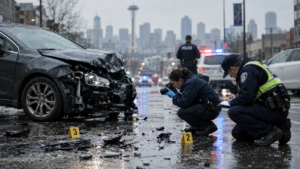
Hit by a Distracted Driver in Seattle? Here’s How to Prove It
Distraction was a factor in 103 traffic deaths in Washington in 2025, one of the state’s “fatal four” leading causes of fatal crashes, alongside impaired driving, speeding, and failing to buckle up, according to the Washington Traffic Safety Commission.
Nationally, NHTSA estimates that someone is injured in a distracted driving crash every half hour and killed roughly every two and a half hours.
Behind almost every one of those numbers is the same problem: the driver almost never admits it. There is no breathalyzer for a text message. The strongest evidence of distraction, the driver’s own phone activity, sits in someone else’s hands and can disappear within weeks if nobody moves to preserve it.
This guide walks through the evidence that actually proves distraction in a Seattle injury claim, and what you should do first to protect it.
Why Distracted Driving Cases Are Hard to Prove
Three things make these cases harder than they should be.
- The driver denies it. There is no roadside test, like a breathalyzer, that can capture what someone was doing on their phone thirty seconds before a crash.
- The best proof does not belong to you. Phone records sit with a cell carrier. In-car event data sits inside the other driver’s vehicle. Neither is handed over just because you ask.
- Evidence degrades fast. Cell carriers purge detailed records after a set retention period. Businesses overwrite surveillance footage, often within days or weeks. If the other vehicle gets repaired or totaled, its black box data can be lost with it.
This is why distracted driving cases are won on investigation and timing, not on the obvious. The sooner someone starts locking down evidence, the stronger the case.
Washington’s Distracted Driving Laws, and Why a Citation Matters
Washington has two statutes that cover distracted driving, and the distinction between them matters for your claim.
RCW 46.61.672, is the state’s “no phones while driving” law. It says you can’t hold or use a phone, tablet, or similar device while driving, even if you’re just stopped at a red light or stuck in traffic. Because of this law, a police officer can pull someone over just for being on their phone. They don’t need any other reason.
RCW 46.61.673, covers other kinds of distraction, like eating, doing your makeup, or reading while driving. The difference is that an officer can’t stop someone for this alone. It has to be tacked on to another violation, like speeding or running a light.
But the catch is if the other driver got a ticket under either law, that helps your case a lot. But in Washington, a distracted driving ticket doesn’t automatically mean the case is won. Unlike a DUI, where breaking the law basically proves fault by itself, a distracted driving ticket (under RCW 5.40.050) is treated as one piece of evidence that a jury still has to weigh, not an automatic win. So it’s strong evidence, but your side still has to argue it, not just point to the ticket and stop there.
If you were hit by a distracted driver anywhere in the Seattle area, our Seattle car accident lawyers can walk through what these statutes mean for your specific claim.
The Evidence That Proves Distraction
No single piece of evidence usually wins a distracted driving case on its own. Proof is built by stacking multiple sources together until the picture becomes hard to argue with. Here is what that evidence looks like and where it comes from.
The police report and any citation. Responding officers document their own observations at the scene, note whether the driver made any admissions, and record whether a device violation was cited under RCW 46.61.672 or 46.61.673. This report is often the starting point for the rest of the investigation.
Driver admissions. Statements like “I looked down for a second” or “I was checking a text” are gold if they were said at the scene, to police, or in front of a passenger or witness. These admissions should be written down and preserved as soon as possible, because memories fade and drivers often change their story once an insurance claim is involved.
Eyewitness statements. Other drivers, passengers, and pedestrians who saw the other driver looking down, holding a phone, or drifting before the crash can provide independent confirmation. Get names and phone numbers at the scene if you are able to, because witnesses are far harder to track down later.
Video footage. Dashcam footage, whether yours or a nearby driver’s, doorbell cameras, business surveillance systems, and traffic or automated cameras can all capture the moments before a crash. This is often the most objective evidence available, but it is also the most perishable, since much of it is overwritten within days. Our related resource on camera footage in Washington car accident claims covers how this kind of footage gets obtained and used.
Phone records. Call logs, text logs, and data-usage records can place device activity at the exact moment of the crash. This is important to understand honestly: phone records are not something you can simply request. They may become obtainable through the litigation process, typically by filing a lawsuit and issuing a subpoena to the driver’s cell carrier. Access is not automatic, and it is not guaranteed in every case, which is one reason the other categories of evidence matter just as much.
The event data recorder, or black box. Most modern vehicles record data like speed, braking, throttle position, and steering input in the moments before a collision. If the data shows a driver never braked or steered away from a hazard that should have been visible, that pattern can point strongly toward inattention.
Cell phone forensic analysis. In more serious cases, a forensic expert can examine a device directly for app usage, screen-on activity, and timestamps that line up with the crash.
Physical and digital scene evidence. The absence of skid marks can suggest a driver never saw the hazard coming. Food wrappers, makeup, or other items visible inside the other vehicle can support a distraction theory. Time-stamped social media activity around the time of the crash has also been used as supporting evidence in some cases.
Act Fast: Preserving Evidence Before It Disappears
The single most important early step is a preservation demand (also called a spoliation letter). It goes to the other driver, their insurance company, and any relevant third parties, like a business with surveillance cameras. It puts everyone on legal notice that they must preserve phone records, the vehicle, and any electronic data connected to the crash.
Timing matters because the clock is already running:
- Cell carriers keep detailed call and data records for only a limited window before purging them
- Businesses often overwrite surveillance footage within days or weeks on a rolling basis
- Vehicles get repaired or sent to salvage, and the black box data can go with them
This urgency is one of the strongest reasons to involve a lawyer early, before the trail goes cold rather than after.
How a Lawyer Proves Distraction
An attorney’s role in these cases is largely about access and speed:
- Subpoena power. A lawsuit lets an attorney obtain phone and carrier records that an individual generally can’t get just by asking.
- Expert analysis. Crash-reconstruction and cell-phone forensic experts can interpret event data recorder output and device activity.
- Fast preservation. Sending preservation letters quickly, then following up to make sure video and vehicle data actually get locked down.
- Insurer management. Handling the insurance company, which has a financial incentive to minimize or deny distraction as a cause of the crash.
What to Do at the Scene and After
If you believe the other driver was distracted, a few steps can make a real difference later:
- Call 911 so the crash gets officially reported.
- Tell the officer if you saw the other driver on a phone or otherwise distracted, and ask that it be noted in the report.
- Photograph everything. The scene, both vehicles, and anything visible inside the other car, like a phone in the driver’s lap.
- Get witness contact info. Names and phone numbers from anyone who saw what happened.
- Preserve your own dashcam footage, and avoid confronting the other driver directly.
- Get medical care promptly, both for your health and because it matters for your claim.
- Contact a lawyer soon so evidence preservation can start before anything disappears.
Common Questions
Is texting and driving illegal in Washington?
Yes. Under RCW 46.61.672, using a personal electronic device while driving, including holding a phone to text, call, or browse, is illegal and is a primary offense, meaning an officer can stop a driver for it alone.
Can you get the other driver’s phone records after a crash?
Sometimes, through the litigation process. Phone records generally become accessible through a lawsuit and subpoena to the carrier, not through a simple request. Access is not automatic and is not guaranteed in every case, which is why other evidence, like video, witnesses, and black box data, matters just as much.
Is distracted driving automatically negligence in Washington?
A distracted driving citation is strong evidence of negligence, but under RCW 5.40.050 it is not negligence per se the way drunk driving often is. It still has to be presented and weighed as part of the overall case.
What if the driver denies being on their phone?
Denials are common in these cases. Video footage, independent witnesses, black box data, and eventually phone records obtained through litigation can all be used to contradict a driver’s denial.
How long do I have to file a distracted driving accident claim in Washington?
Generally three years from the date of the crash, under RCW 4.16.080. Missing this deadline typically bars the claim, so it is worth speaking with an attorney well before the deadline approaches.
What This Means for Your Claim
Distraction remains one of Washington’s fatal four causes of traffic deaths even as overall crash numbers have started to fall. That statistic reflects a hard reality: distraction cases are winnable, but they turn on evidence that fades fast. The sooner an investigation starts, whether that is a preservation letter going out or a witness being contacted before they move on, the stronger the proof tends to be.
If you were hit by a driver you believe was distracted, our Seattle distracted driving accident attorneys offer free consultations to review what happened and what evidence may still be available.
This article is for general informational purposes and does not constitute legal advice. Contacting Brumley Law Firm does not create an attorney-client relationship.
Sources
- Washington State Legislature – RCW 46.61.672, using a personal electronic device while driving.
- Washington State Legislature – RCW 46.61.673, dangerously distracted driving.
- Washington State Legislature – RCW 5.40.050, breach of statute as evidence of negligence.
- Washington State Legislature – RCW 4.16.080, three-year statute of limitations for personal injury claims.
- Washington State Department of Licensing – Washington’s distracted driving overview.
- Washington Traffic Safety Commission – Washington traffic fatality and distraction data.
- NHTSA – National distracted driving data.