


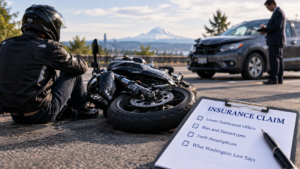
Motorcycle Accident in Kent, WA? Here’s Why Insurance Companies Treat Bikers Differently
Motorcycles make up only about 3 percent of registered vehicles and crashes in Washington. Yet riders accounted for 16 percent of all traffic deaths in the state between 2021 and 2025, according to the Washington Traffic Safety Commission.
Preliminary 2025 data shows 104 motorcyclist deaths statewide, down from 113 in 2024 and a 2023 peak of 142, but still far out of proportion to how few bikes are actually on the road.
That same imbalance shows up again after a crash, just in a different form. Insurance adjusters often start reviewing a motorcycle claim from a place of suspicion rather than sympathy, assuming the rider was speeding, weaving, or “asking for it” simply by being on two wheels, before they’ve looked at a single fact of the case.
Here’s where that bias comes from, the specific tactics it shows up as, and how a Kent claim pushes back with Washington law and real evidence.
Why Insurers Approach Motorcycle Claims Differently
A few forces combine to make motorcycle claims harder than car claims, and none of them have much to do with who actually caused the crash.
The “inherent recklessness” assumption: Adjusters, and later juries, often carry a cultural stereotype that riders are more likely to be careless, regardless of what the evidence actually shows. Legal and insurance-industry sources refer to this pattern directly as “rider bias.”
Bigger injuries mean bigger pushback, not more sympathy: Riders don’t have a frame, airbags, or crumple zones between them and the road. That means motorcycle injuries tend to be more severe and more expensive to treat. Rather than working in the rider’s favor, a larger claim usually draws sharper scrutiny and a harder fight from the insurer.
Comparative fault becomes a bargaining chip: Washington follows a pure comparative negligence rule, which means a rider can still recover damages even if they were partly at fault. Insurers know this, so they often open settlement talks by assigning the rider outsized blame to shrink the payout, even in crashes clearly caused by the other driver, like a car turning left in front of a rider who had the right of way.
Bias Tactics You’ll Actually See in a Washington Claim
These aren’t abstract concepts. They show up as specific arguments adjusters make, and Washington law has something to say about each one.
The helmet defense: Washington has a universal helmet law under RCW 46.37.530. If a rider wasn’t wearing a DOT-approved helmet, insurers will often try to use that against the entire claim. In reality, this can only fairly reduce damages tied specifically to head or facial injuries, not the whole case, and fault still has to be proven rather than assumed.
The “you should’ve used the shoulder” claim: Some adjusters suggest a rider should have squeezed to the side of the lane or ridden on the shoulder. Washington law says the opposite. RCW 46.61.608 entitles every motorcycle to full use of a lane, and makes it illegal for another vehicle to crowd a rider out of it.
The same statute also confirms lane splitting and lane filtering are illegal in Washington, which cuts both directions: if a rider genuinely was splitting lanes, that’s real fault exposure, not something a fair claim should paper over.
The gear and visibility angle: Adjusters sometimes argue a rider’s clothing or the bike itself was hard to see, shifting the blame for the other driver’s failure to look. This is more of a credibility tactic than a legal defense, since Washington law puts the duty to see and yield on every driver on the road, not just the ones on four wheels.
The “speeding rider” narrative: Statewide data does show that rider speeding and impairment are real, common factors in fatal motorcycle crashes. That statistical backdrop gives adjusters an easy story to reach for, even in individual cases where there’s no actual evidence either factor was involved.
Fast, lowball early offers: Because motorcycle injuries often mean high medical bills right away, some insurers move quickly with a settlement offer before a rider has finished treatment or found a lawyer, hoping to close the claim out before its real value is clear.
What Actually Determines Fault in a Kent Motorcycle Claim
Washington law, not an adjuster’s first impression, is what’s supposed to decide fault.
- Pure comparative negligence. Under RCW 4.22.005, fault is a percentage, not a yes-or-no. A rider found 20 percent at fault still recovers 80 percent of their damages. Unlike some states, there’s no cutoff percentage that bars recovery entirely.
- The statute of limitations. Generally three years from the date of the crash, under RCW 4.16.080.
- What actually builds a fair fault picture: the police report, independent witness statements, physical evidence like skid marks and point of impact, any citation issued to either driver, and surveillance or dashcam footage where it exists.
If you’re dealing with a motorcycle claim in Kent, our Kent motorcycle accident lawyers can walk through how these rules apply to your specific crash.
How a Kent Attorney Counters Rider Bias
Pushing back on these assumptions is mostly a matter of not letting the insurer’s narrative stand unchallenged.
- Rebuild the crash, not the stereotype. Focus on the actual mechanics: point of impact, right-of-way, sightlines, and timing, rather than letting “the rider was probably reckless” go unquestioned.
- Bring real data to the table. Pull WTSC and WSDOT crash data and independent witness statements to counter unsupported claims that the rider was likely speeding or at fault.
- Don’t let treatment get rushed. Push back on early lowball offers by fully documenting the scope of injuries and treatment before accepting anything.
- Bring in experts when fault is contested. In more disputed cases, accident reconstruction experts can help establish exactly what happened.
Our related post on shoulder riding rules for Kent motorcyclists covers one of these bias tactics in more depth, specifically the assumption that riders should be riding on the shoulder in the first place.
What to Do After a Motorcycle Crash in Kent
- Call 911 and get an official police report on record.
- Get medical care immediately, even if an injury seems minor at first.
- Photograph everything. The scene, your bike, your gear, and any damage to the other vehicle.
- Get witness names and phone numbers before they leave the scene.
- Avoid giving a recorded statement to any insurer, including your own, before talking to a lawyer.
- Don’t accept an early settlement offer before your treatment is complete and the full cost of your injury is known.
Common Questions
Does Washington require motorcycle helmets?
Yes. Under RCW 46.37.530, all riders and passengers must wear a DOT-approved helmet.
Can I still recover damages if I was partly at fault?
Yes. Washington is a pure comparative negligence state under RCW 4.22.005. A rider found partly responsible can still recover, with the payout reduced by their percentage of fault.
Is lane splitting legal in Washington?
No. RCW 46.61.608 prohibits riding between lanes or rows of vehicles, though the same law also protects a rider’s right to full use of a lane.
Why do insurers offer motorcyclists less than car accident victims?
Insurers often start from an assumption of rider recklessness and lean on tactics like the helmet defense or fast, early lowball offers, even though Washington law requires fault to be proven rather than assumed.
How long do I have to file a motorcycle accident claim in Washington?
Generally three years from the date of the crash, under RCW 4.16.080.
What This Means for Your Claim
Riders make up a small share of the vehicles on Washington’s roads but a disproportionate share of the deaths and serious injuries. That’s exactly why insurers scrutinize motorcycle claims harder instead of treating riders more sympathetically. Rider bias is real, but it’s a pattern to counter with evidence and Washington law, not something that decides a case by default.
If you were hurt in a motorcycle crash in Kent, our Kent motorcycle accident attorneys offer a free consultation to review what happened and push back on any assumptions the insurer is making about your case.
This article is for general informational purposes and does not constitute legal advice. Contacting Brumley Law Firm does not create an attorney-client relationship.
Sources
- Washington State Legislature – RCW 46.37.530, motorcycle helmet requirement.
- Washington State Legislature – RCW 46.61.608, full use of lane and lane-splitting prohibition.
- Washington State Legislature – RCW 4.22.005, pure comparative negligence.
- Washington State Legislature – RCW 4.16.080, three-year statute of limitations.
- Washington Traffic Safety Commission – 2025 motorcyclist fatality data and five-year crash-share statistics.
- Washington Traffic Safety Commission – ongoing motorcyclist crash data hub.
