
Everett Personal Injury Lawyer: Navigating Forklift and Warehouse Accidents in 2026
Everett Personal Injury Lawyer: Navigating Forklift and Warehouse Accidents in 2026
Overview: Everett Personal Injury Lawyers and Warehouse Risks
Everett’s industrial economy makes forklift and warehouse safety a serious issue for workers, contractors, delivery drivers, vendors, and visitors. In 2026, warehouse accident trends in Everett continue to reflect risks tied to aerospace support, manufacturing, maritime operations, construction supply chains, loading docks, and vehicle traffic around industrial sites. The Port of Everett describes itself as Washington’s third-largest container port and a breakbulk cargo facility supporting aerospace, military, construction, manufacturing, agriculture, energy, and forest products industries.
For an Everett personal injury lawyer, forklift and warehouse accident cases often require more than a basic insurance claim. These cases may involve workers compensation benefits, third-party liability, product defects, negligent maintenance, unsafe traffic flow, inadequate training, or overlapping vehicle-related claims.
Brumley Law Firm focuses on Washington personal injury law. Our legal team has more than 30 years of combined experience and has handled many injury matters. Past results do not guarantee future outcomes, and every case depends on its specific facts, evidence, and applicable law.
What To Do After a Forklift or Warehouse Accident in Everett
After a forklift or warehouse accident, the first priority is medical treatment. Even if symptoms seem minor, seek immediate medical attention because traumatic injuries, traumatic brain injuries, internal injuries, spinal cord injuries, and soft-tissue damage may worsen after the initial shock wears off.
Report the workplace accident to a supervisor, site manager, or safety officer as soon as possible. If the injury happened at work, the Washington State Department of Labor & Industries explains that approved workers’ compensation claims may cover medical care directly related to the injury and may also involve wage replacement benefits when a doctor certifies that the worker cannot work.
Preserve clothing, damaged personal protective equipment, boots, gloves, hard hats, broken pallets, packaging, and any equipment involved. Washington L&I states that the scene of a work-related incident must be preserved until L&I investigates, although equipment may be moved when necessary to assist a victim or prevent further harm.
Contact experienced personal injury lawyers promptly, especially if a forklift operator, warehouse contractor, delivery company, equipment manufacturer, maintenance vendor, property owner, or another outside party may have contributed to the incident. Early legal representation can help preserve CCTV footage, witness statements, inspection records, and electronic data before they are lost.
Immediate Steps at the Scene
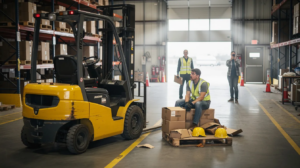
If it is safe to do so, photograph the scene before items are moved. Capture the forklift position, vehicle positions, rack damage, floor markings, aisle layout, warning signs, lighting conditions, broken pallets, spills, debris, tire marks, and any visible safety hazards.
Collect witness names and contact details from coworkers, supervisors, drivers, subcontractors, customers, or nearby construction workers. In many personal injury cases, witness statements become critical when insurance companies later dispute how the personal injury accident occurred.
Note environmental and safety hazards. Examples include obstructed mirrors, blind corners, overloaded racks, missing barriers, poor lighting, wet floors, uneven surfaces, defective brakes, lack of spotters, unclear pedestrian walkways, and unsafe forklift traffic patterns.
How Personal Injury Claims for Forklift Accidents Work in Washington State
A personal injury claim for a forklift accident usually begins with evidence gathering, liability analysis, medical documentation, and insurance notice. The claim may involve a personal injury lawsuit if insurance adjusters refuse a fair settlement or if the legal process requires court intervention.
In Washington State, most personal injury claims must be filed within three years under RCW § 4.16.080, which applies to actions for injury to the person or rights of another. Missing this deadline can result in losing the right to pursue financial compensation, although counsel should evaluate discovery-rule issues when an injury was not reasonably discoverable right away.
Washington follows a pure comparative negligence rule. Under RCW § 4.22.005, contributory fault reduces compensatory damages in proportion to the injured person’s share of responsibility, but it does not automatically bar recovery. For example, if a person is found 40% at fault, compensation is reduced by 40%. There is generally no comparative negligence cutoff unless the injured party is found 100% responsible for the harm.
Potential defendants may include a negligent forklift operator employed by another company, a delivery driver, a maintenance contractor, a general contractor, a warehouse property owner, a loading dock operator, an equipment rental company, or a manufacturer of defective forklift parts. Warehouse accidents in Washington often involve complex third-party liability because several companies may control different parts of the worksite.
Filing timelines can change when government entities or public facilities are involved. Washington’s local government tort claim statute requires claim-presentment procedures before a lawsuit may begin, so an experienced attorney should review possible public-entity issues early.
Common Injuries, Damages, and Lost Wages After Warehouse Accidents
Forklift incidents can cause severe injuries, including crush injuries, fractures, amputations, burns, spinal cord injuries, traumatic brain injuries, nerve damage, shoulder injuries, knee injuries, internal bleeding, and catastrophic injuries. Fall accidents from loading docks, elevated platforms, trailers, or warehouse ladders can also lead to long-term disability.
Damages may include medical expenses, medical bills, future medical expenses, physical therapy, rehabilitation, prescription costs, assistive devices, transportation to medical appointments, home care, and out-of-pocket medical costs. Medical records from medical professionals help connect the injury to the accident and document the extent of physical pain, emotional distress, and long-term limitations.
Lost wages and lost income are usually calculated with pay stubs, W-2s, tax records, employer schedules, overtime records, union records, job descriptions, and disability slips. When serious injuries affect promotion opportunities, hours, job duties, or the ability to return to warehouse work, vocational and economic experts may estimate future earning capacity.
Financial recovery may also account for emotional distress caused by the accident, the emotional toll on the injured person’s family, loss of enjoyment of life, permanent impairment, and pain and suffering. If a workplace accident results in wrongful death, surviving family members may need guidance about wrongful death benefits, workers’ compensation death benefits, and a separate wrongful death claim when permitted by Washington law.
Proving Negligence in an Everett Personal Injury Case
To prove negligence in an Everett personal injury case, the legal team must show that another party owed a duty of care, failed to act reasonably under the circumstances, and caused damages. This may involve forklift routes, operator conduct, warning systems, pedestrian barriers, equipment condition, lighting, supervision, and training.
CCTV and surveillance footage are often among the most important evidence. A personal injury law firm may send preservation letters to warehouse owners, employers, contractors, and insurers requesting that video, inspection logs, forklift telematics, maintenance records, and incident reports be saved.
OSHA’s powered industrial truck rules address forklift safety requirements, including design, maintenance, use, and operator training. OSHA also states that powered industrial truck operators must be trained and certified by their organizations under 29 CFR 1910.178(l), which can make training and certification records important evidence in 2026 forklift claims.
Accident reconstruction experts may evaluate visibility, speed, impact angles, stopping distance, floor conditions, load weight, pallet placement, and whether the forklift or warehouse layout created an unreasonable risk. Subpoenas may be used to obtain maintenance logs, inspection checklists, employer training records, prior incident reports, and contractor safety agreements.
Workers’ Compensation Versus Personal Injury Claims for Construction Accidents and Warehouse Injuries
A [workers compensation claim](Labor & Industries https://lni.wa.gov/claims/for-workers/claim-benefits/) is usually the first claim for employees injured on the job. Washington workers’ compensation can cover medical treatment, some wage replacement, return-to-work help, disability benefits, and pensions for severely injured workers. It does not compensate for pain and suffering in the same way a personal injury claim can.
In Washington, injured workers generally cannot sue their employer for a workplace injury, but they may have a separate injury claim against a third party. L&I explains that if someone other than the employer or a coworker caused the workplace injury, the injured worker may take legal action against that third party.
This distinction matters in construction accidents and warehouse injuries. For example, a warehouse employee hit by a subcontractor’s forklift, a delivery truck, defective equipment, or a maintenance vendor’s unsafe work may have both workers compensation benefits and a third-party personal injury claim.
Benefit coordination is important because double recovery issues can arise when workers’ compensation has already paid medical bills or wage benefits. An experienced personal injury attorney can coordinate the workers’ compensation claim and third-party claim to protect the client’s overall recovery.
How Personal Injury Lawyers Work To Pursue Fair Financial Recovery
Experienced personal injury lawyers build a demand package that tells the full story of the accident, injuries, treatment, lost wages, future medical expenses, future earning capacity, and non-economic losses. A strong demand package may include photos, witness statements, medical records, wage records, expert reports, incident reports, inspection logs, and documentation of medical bills pile pressure on the household.
Insurance companies often evaluate claims narrowly, especially when several parties dispute responsibility. Insurance adjusters may question whether the injury came from the forklift incident, whether treatment was necessary, whether lost wages are supported, or whether the injured person contributed to the accident.
A personal injury lawyer can hire medical experts, life-care planners, vocational specialists, economists, and accident reconstruction professionals to clarify the long-term impact of serious injuries. This helps show not only current medical expenses, but also future treatment, diminished work capacity, emotional distress, and permanent limitations.
Brumley Law Firm prepares cases with litigation in mind. The firm’s client-focused approach and personal injury experience help clients understand the legal process and organize the evidence needed to support their claims.
Car Accident and Vehicle-Related Warehouse Claims
Some warehouse cases also involve a car accident, truck accidents, delivery van collisions, backing incidents, loading dock crashes, or vehicle-pedestrian impacts in industrial yards. These claims may involve property damage, police reports, driver insurance information, commercial vehicle records, and photographs of scene debris.
Vehicle-related evidence should include insurance claims information, license plate details when available, company names on delivery paperwork, dashcam footage, warehouse gate logs, delivery schedules, and photographs of the vehicles before repairs. If a third-party driver caused the crash through someone else’s negligence, the injured person may be able to recover compensation outside the workers’ compensation system.
Costs, Fees, and Getting Started With an Everett Personal Injury Lawyer
Many Washington personal injury attorneys handle cases on a contingency fee basis. In a contingency arrangement, attorney fees are generally paid from any recovery rather than billed hourly upfront. The written fee agreement should explain the fee percentage, case expenses, when expenses are deducted, and whether the client may be responsible for any costs. Washington Courts’ RPC 1.5 also requires contingent fee agreements to be in writing and signed by the client.
A free initial consultation gives Everett accident victims and families a chance to discuss what happened, what evidence exists, what medical treatment has started, and whether a third-party claim may be available. Before the meeting, bring photos, witness information, medical records, medical bills, wage documentation, the workers’ compensation claim number, incident reports, and any letters from insurance companies.
If Brumley Law Firm accepts the matter, the client retainer and representation agreement should explain the contingency fee basis, case expenses, client responsibilities, communication expectations, and the scope of legal representation.
Frequently Asked Questions About Everett Personal Injury Claims in Washington State
How does comparative negligence affect recovery?
Washington law allows injured people to pursue compensation even if they are partially at fault. If an injured person is 40% responsible, the award is reduced by 40%, but the claim is not automatically barred unless the injured person is entirely responsible for the accident.
What is the filing deadline for Washington State personal injury claims?
Most personal injury claims in Washington State must be filed within three years under RCW § 4.16.080. Because evidence can disappear long before the deadline, injured people should act quickly after a serious accident.
Can I receive workers’ compensation and file a third-party suit?
Yes, in some cases. Workers’ compensation may cover workplace injuries, while a separate third-party personal injury lawsuit may be available if someone other than the employer or coworker contributed to the harm. Coordination is important because reimbursement and benefit-offset issues may apply.
What should I bring to a free consultation?
Bring medical records, medical bills, photos, witness statements, employer reports, wage records, workers compensation benefits letters, insurance claims documents, and any communication from insurance companies. If the case involves a forklift, bring any information about operator training, equipment maintenance, inspection records, and the warehouse company involved.
Talk With Brumley Law Firm About an Everett Warehouse Accident
Forklift and warehouse accidents can leave personal injury victims facing serious injuries, medical expenses, lost wages, emotional distress, and uncertainty about the legal process. These cases may involve workplace injuries, car accident evidence, construction workers, contractors, equipment companies, truck accidents, fall accidents, and other personal injury cases such as premises liability, dog bites, or wrongful death.
Brumley Law Firm offers a no-cost initial consultation for Everett personal injury victims and families who want to understand their legal options. Contacting the firm does not create an attorney-client relationship. Representation begins only after the firm agrees to accept the matter and the client signs a written agreement.
You may contact Brumley Law Firm at (833) 740-2275.